
Notes on “The Conformist”
General Overview
The Conformist (Il conformista) is a 1970 film by Bernardo Bertolucci, adapted from Alberto Moravia’s novel. It stars Jean-Louis Trintignant as Marcello Clerici, a civil servant in Mussolini’s Italy whose desperate need to seem ordinary and accepted leads him into fascism and into a mission against his former professor, an anti-Fascist exile in Paris.
What makes it famous is the way its style and ideas are fused. Bertolucci uses a fractured flashback structure, while cinematographer Vittorio Storaro turns Marcello’s inner life into image through controlled compositions, expressive light and shadow, and the imposing design of fascist-era spaces. The American Society of Cinematographers calls it a milestone in motion-picture photography, and BFI notes that Storaro’s dynamic cinematography went on to influence directors such as Martin Scorsese and Francis Ford Coppola. Frankly, you can’t miss the influences; when you realize that “Conformist” was released just a couple of years before The Godfather, you would not be misguided to speculate about what Coppola and his cameraman, Gordon Willis, took away from Storaro. Look at just about any scene, although the one that comes to mind for me is the long shot of the car parked on expressway. (“Leave the gun. Take the cannoli.”)
The Conformist played an important role in shaping the visual world around The Godfather. After seeing Bertolucci’s film, Francis Ford Coppola was so impressed that he screened it for Willis during pre-production. Still, Willis developed a highly personal style rooted in simplicity, naturalism, and a deliberately dark, “brown-and-black” palette. Building on what Coppola signaled regarding Conformist, Willis pursued a restrained approach that emphasized realism and mood.
At heart, it is a movie about conformity as moral collapse: a man so frightened of difference, guilt, and exposure that he hands himself over to authoritarian power. The recurring ideas are repression, sexuality, blindness, and the refusal to face truth. Storaro explicitly connected one of the film’s key scenes to Plato’s cave, and the film repeatedly frames Marcello in shadows and enclosed spaces, as though he is hiding from himself. (The American Society of Cinematographers)
It was nominated for the Academy Award for adapted screenplay, and its reputation has only grown over time, especially among cinematographers. One warning: it includes sexual trauma and brutal political violence. (Awards Database)
Stuart Jeffries comment in “The Guardian.”
“A repressed upper-class intellectual is hired by Mussolini's fascist goons to go to Paris and kill a leading dissident who was once his philosophy tutor. Such is the premise for one of the most poetic and influential films ever made. Coppola, Scorsese and Spielberg all cite this adaptation of Alberto Moravia's novel as a profound influence on their films. Coppola even lured Bertolucci's director of photography, Vittorio Storaro, to the Philippines to bring his talents to bear on Apocalypse Now.
What wowed them? The symbolic colour-coded photography, the virtuosic flashback structure, and, no doubt, the idea that you could explore something as seemingly unfilmable as the psychopathology of fascism in that paradoxical object, an art film filled with car chases, sex and violence.
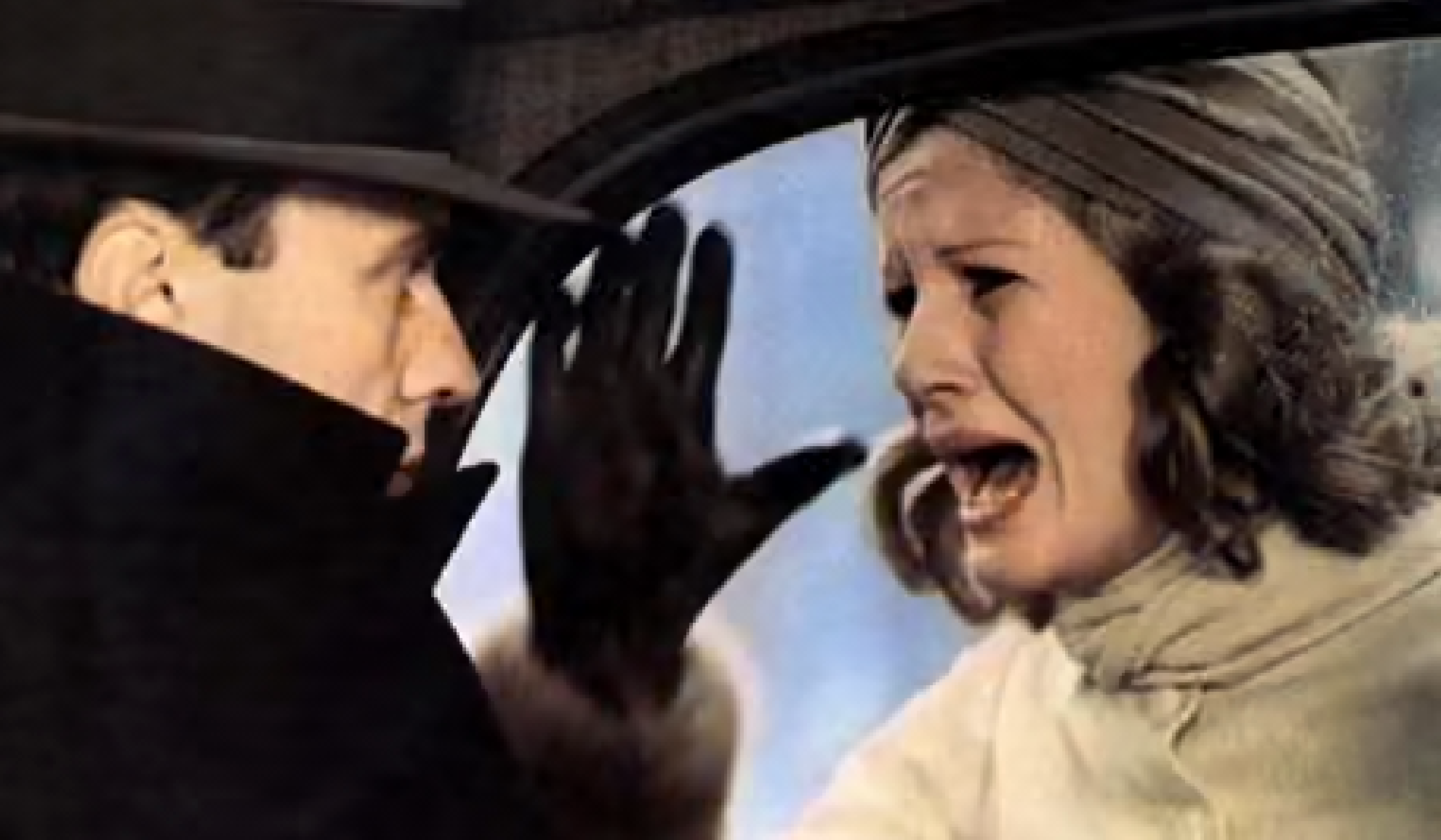
Jean-Louis Trintignant was never more sinister than here, as Marcello Clerici – particularly when he gazes icily at his doomed lover through the window of his locked car door before watching her flee through the Piedmontese woods to be murdered – a scene shot with hand-held camera in order to make the hit feel inept and squalid. Indeed, The Conformist is a compendium of virtuosic flourishes: the chilly framing of iconic fascist buildings such as the Esposizione Universale Roma in Rome and the Palais de Tokyo in Paris; the expressionist angles when Clerici visits his dotty mother. And, best of all, the ingenious sequence in a Parisian cafe in which Clerici's reluctance to participate in a dance leaves him surrounded by a tightening spiral of dancers shot from above, making him appear to us exactly what he is: a conformist alone in any crowd. Rarely has cinema been so daring or freighted.”
Canby: "The Conformist" - A Chronicle of Decadence
Canby describes the film as a "superior chronicle" that equates the rise and fall of Italian Fascism with the personal trauma of Marcello (Jean-Louis Trintignant). He notes that Marcello’s obsession with "normality" and social adequacy is a shield against a childhood encounter he perceives as shameful. This drive leads him to Paris in 1936 to assist in the assassination of his former philosophy professor—a mission he treats as a test of his own conformity.
Canby is particularly struck by Bertolucci’s "rich, poetic and baroque" style, which he feels is a distinct improvement over the original novel’s "sometimes tiresomely lean prose." He praises the film’s extraordinary ability to recall the 1930s, from the "awful modern architecture" to the specific sounds of the radio. He accepts Bertolucci’s own description of the film as "operettic," noting that its stylized depiction of upper-middle-class decadence adds to its vitality. He highlights how Bertolucci complicates the "equation of politics with sex," specifically through:
The Ending: The director changed the original novel’s conclusion to lean into ambiguity, modifying the entire weight of the film.
Memorable Sequences: Canby points to the "absolutely marvelous" sequence in the Parisian dance hall and the surreal visit to Marcello's father in a mental hospital as examples of the film’s unique beauty.